Hireme.so · 2026
One focused workspace for every job you apply to.
Hireme.so is an AI suite for resumes, cover letters and interview prep. Paste a job link, get a tailored application, and keep every role on track.
- Role
- Scope
- Platform
- Focus
- Status
In short
- Challenge
- Tailoring a resume for every role takes too long, so most people send the same one everywhere.
- Approach
- Turn a master resume into a tailored application in one step, with AI that edits beside you and shows why.
- Outcome
- A live product where each role gets its own resume, cover letter and interview prep.
Context
A job search is a project, but people run it from a dozen tabs.
Every application needs a resume, a cover letter, the job post, a way to track it, and notes for the interview. Most people juggle these across Google Docs, a spreadsheet, ChatGPT and their inbox. Each switch costs focus, and the work rarely gets tailored.
Before Hireme
- Google Docs
- Spreadsheet tracker
- ChatGPT
- Job boards
- Notes app
Hireme.so
One workspace per application
Tailored, tracked, ready
Resume, letter and prep in one place
Problem
Generic resumes get filtered out. Tailored ones take too long.
Recruiters and applicant tracking systems (ATS) look for the skills named in the job post. Tailoring for each role works, but doing it by hand is slow, so people stop. I saw this as a friction problem, not a writing problem.
How might we make a tailored application the fastest option, not the slowest one?
The core jobs to be done:
- Start from my best resume, not a blank page.
- Show me which keywords this role cares about.
- Let me stay in control of what AI changes.
- Keep every application and its stage in one place.
Principles
AI should help you say it better, not say it for you.
Four observations shaped the product. Each one maps to a specific design decision.
- 01
We learned
People don’t want AI to write their resume. They want help phrasing it.
So I designed
AI works at the bullet level. Every line has “Generate with AI”, and every edit stays editable. Human-in-the-loop by default.
- 02
We learned
Tailoring only feels worth it when you can see the match.
So I designed
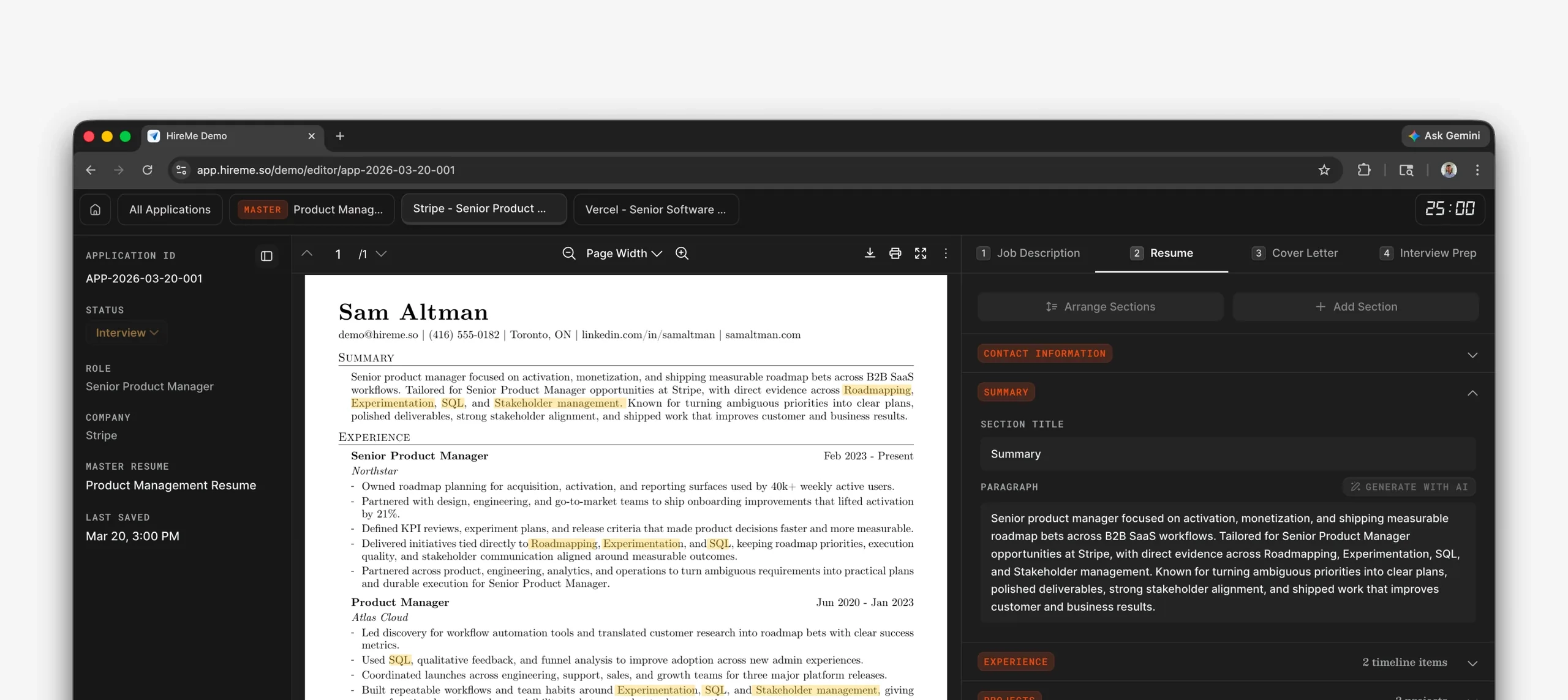
Keywords from the job post are highlighted right on the resume, so the fit is visible at a glance.
- 03
We learned
People judge a resume by how it looks on the page.
So I designed
A live PDF preview sits beside the editor. What you see is exactly what you send.
- 04
We learned
One base resume never fits every career direction.
So I designed
Master resumes per track (Design, Engineering, Product) feed tailored application resumes.
Decisions
One repeatable loop for every application.
Each application follows the same four steps, shown as numbered tabs. The structure lowers cognitive load: users always know where they are and what comes next.
The application loop
- 01
Job details
Paste a link or description
- 02
Resume
Tailored from a master resume
- 03
Cover letter
Drafted from the same context
- 04
Interview prep
Practice for this exact role
How AI shows up in the editor
Fully generated resume
DroppedFast, but people don’t trust or send what they didn’t shape.
Structured editor
ChosenPrecise control over every field, with AI on each bullet.
Copilot chat
ChosenFor open-ended asks like “make this sound more senior”. Lives in a tab beside the editor.
Solution
Paste a job link. Get an application you’re proud to send.
Start from the role, not a blank page
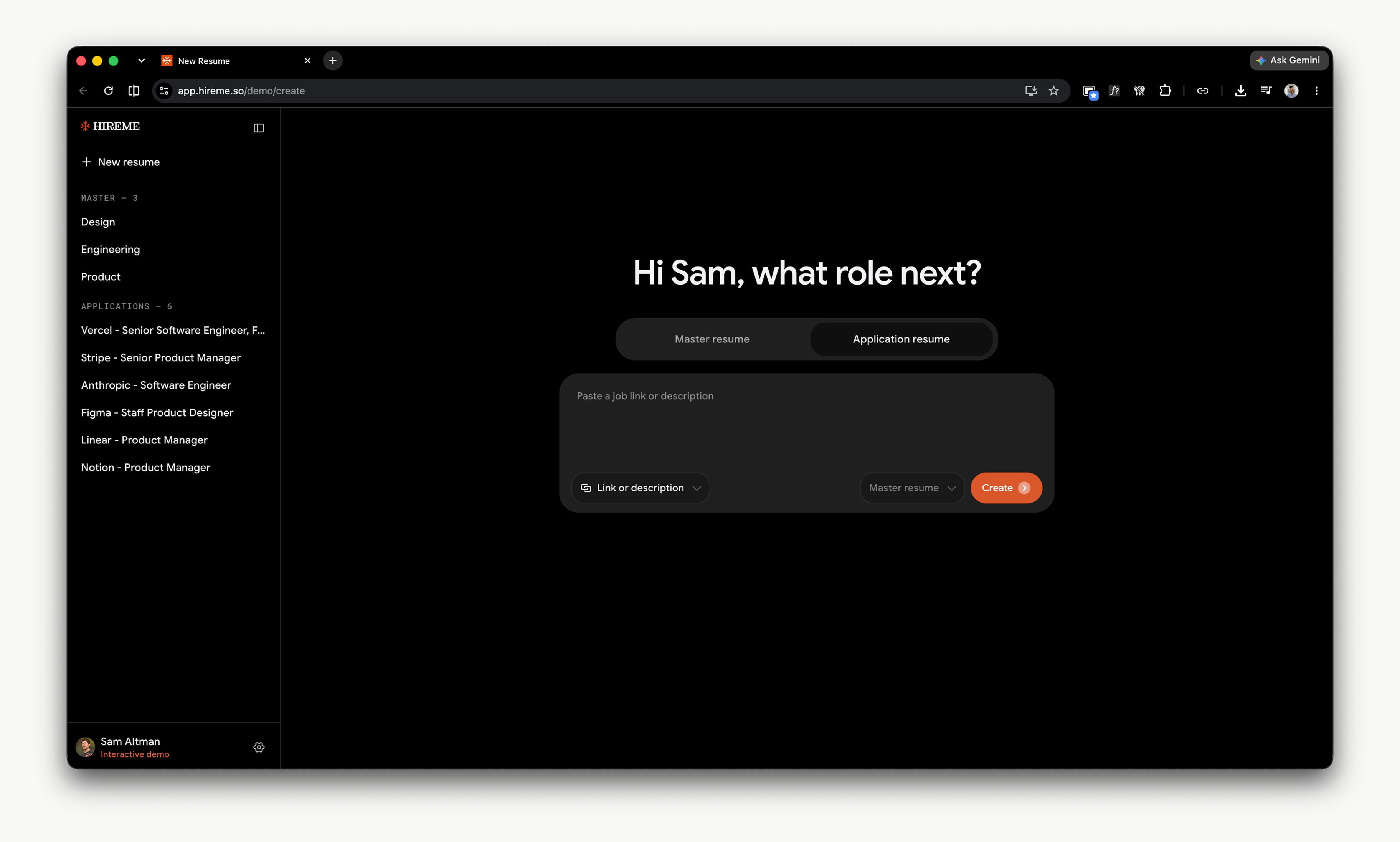
Paste a job link or description, pick a master resume, and Hireme drafts a tailored application resume. The sidebar keeps master resumes and active applications apart, so the information architecture matches how people think about their search.
Edit with a live preview
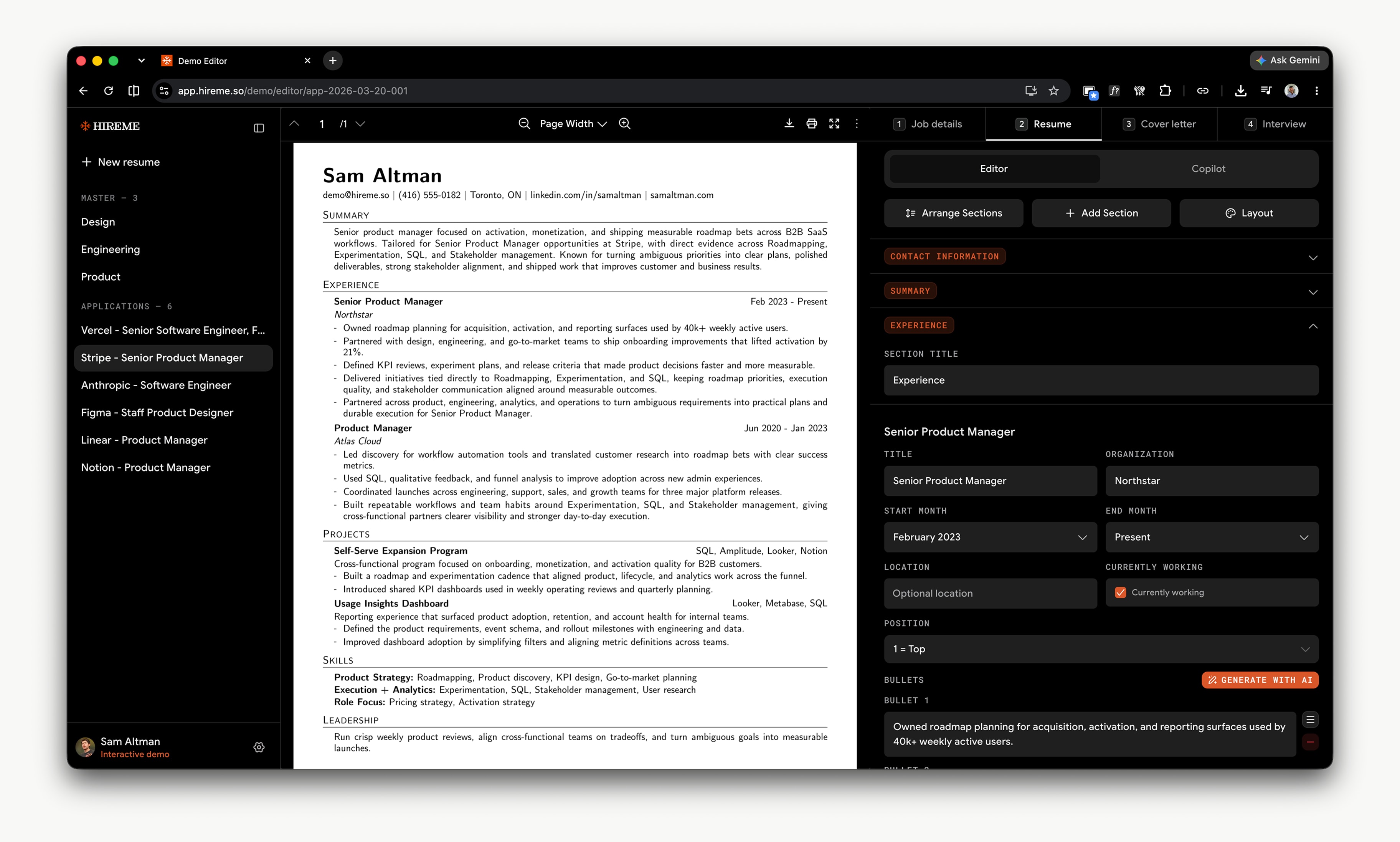
A split-pane layout: the real PDF on the left, a structured editor on the right. Sections can be rearranged, and any bullet can be rewritten with AI. Every change shows up on the page right away.
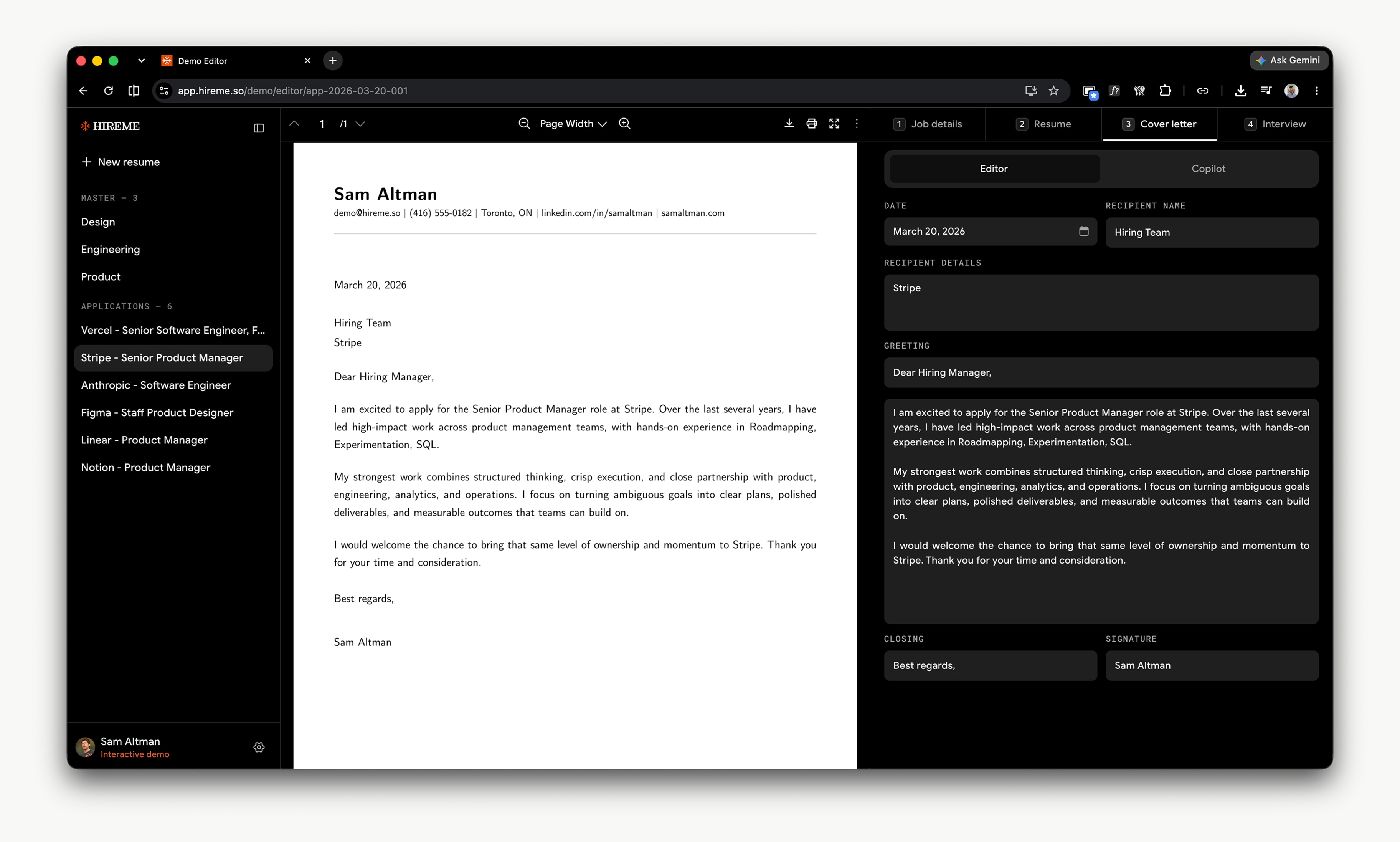
Cover letters in the same flow
The cover letter reuses the job context and resume, so it starts relevant. Same layout, same controls, no new patterns to learn.
Impact
Shipped and live, from first sketch to production code.
- Web app in production
- Live
- Per application
- 4 steps
- Workspace per role
- 1
I designed the product and wrote the front-end myself. Owning both sides meant design decisions shipped as intended, and I could test ideas in real code instead of static mockups.
Reflection
Design AI that people can edit, not just accept.
The biggest lesson was about trust. People only send what they feel ownership over, so the AI had to be a collaborator, not an author. Visible keyword matches and a live preview did more for trust than any amount of generated text.
What I would do next:
- Track interview rate per tailored application as the North Star metric.
- Generate mock interview questions straight from the job post.
- Run usability tests on first-time onboarding to shorten time to first resume.