Brilliant.org · 2026
An AI tutor that helps you get unstuck without giving the answer away.
A concept for an agentic learning companion inside Brilliant, voiced by Koji, the brand’s mascot. It nudges, asks questions and adapts, so learners keep their “aha” moment.
- Role
- Type
- Product
- Focus
- Deliverable
In short
- Challenge
- When a puzzle gets too hard, learners stall. Static hints are either too vague or give the answer away.
- Approach
- An agent that spots friction early, then escalates help one small step at a time. The learner stays in control.
- Outcome
- Three end-to-end flows, a conversation model, and a plan to test it with real learners.
Context
Brilliant teaches by doing. Getting stuck breaks that.
This is a self-initiated concept made for my portfolio. It is not affiliated with or endorsed by Brilliant.org.
Brilliant replaces passive lectures with hands-on puzzles that build intuition for math, science and computer science. This concept builds on their brand refresh and explores a shift from static help to an agentic learning experience: an AI that acts like a patient tutor.
- Learners lose confidence when they get stuck with no guidance.
- Static hints don’t know where the learner’s logic broke.
- Once momentum breaks, many learners leave the lesson.
Problem
Too little help and learners quit. Too much and they stop learning.
Learning science calls the useful kind of difficulty productive struggle. The goal was to protect it. Help had to be sized to the exact gap in the learner’s thinking.
The hint problem
- Too vague
- “Think about the angles.” The learner stays stuck.
- Productive struggle
- A nudge sized to the learner’s exact gap.
- Too specific
- “The answer is 42.” The challenge is gone.
How might we help students when they get stuck, without taking away the struggle that makes learning stick?
Research
Learners don’t want answers. They want a nudge in the right direction.
Learners often repeat the same mistake without knowing why. But handing over the answer kills the sense of achievement. The insight was simple: nudge, don’t tell.
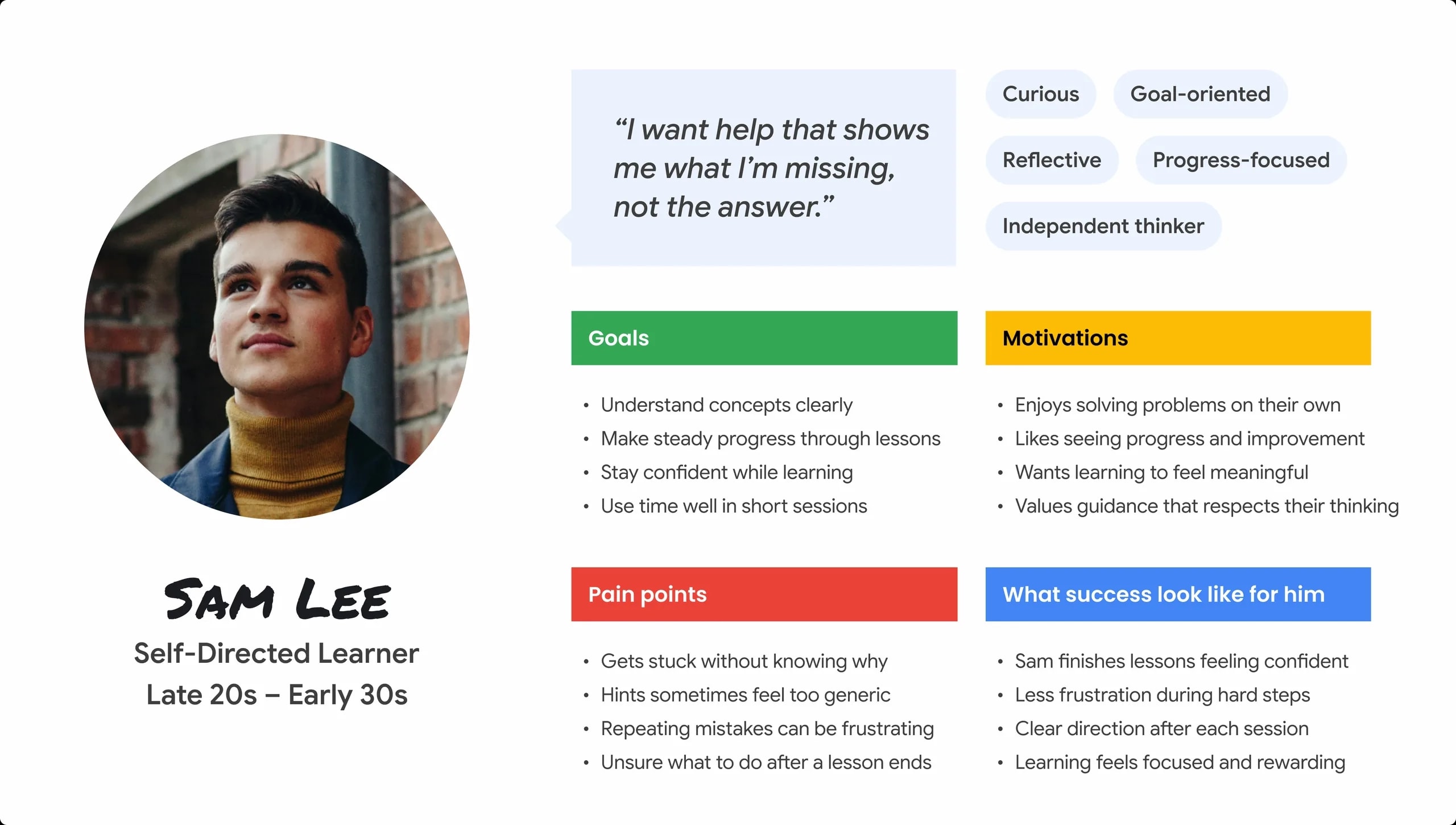
Meet Sam, the motivated learner
Sam is curious and independent. They love the “aha” moment of figuring something out alone, but need a lifeline when a logic gap stops their progress.
- 01
Sam needs
To build confidence through solving problems on their own.
So Koji will
Offer the smallest useful hint first, never the answer.
- 02
Sam needs
Help that understands their specific mistake.
So Koji will
Read attempts and time spent to find the real logic gap.
- 03
Sam needs
Control over when and how help appears.
So Koji will
Make every nudge optional and easy to dismiss.
Strategy
An agent that watches, thinks, and only then steps in.
Here, agentic means the AI acts on its own signals. It watches progress quietly and offers help at the moment a learner is about to hit a wall, not before.
Koji’s decision loop
- 01
Observe
Attempts, pauses, time per puzzle
- 02
Reason
Find the specific logic gap
- 03
Suggest
A small, optional nudge
- 04
Assist
A tool or quick review if still stuck
- 05
Adapt
Learn what helped this learner
Each response tunes the next nudge, so help gets more personal over time.
Help escalates one rung at a time
Koji never jumps to the answer. Each level of help is only offered if the one before didn’t work, which keeps the learner doing as much of the thinking as possible.
The help ladder
Learner does the thinking
1. Nudge
A question that points at the key idea.
2. Hint
Names the concept or rule to use.
3. Example
A similar worked problem to compare against.
4. Walkthrough
Step by step, only when the learner asks.
Koji does more of the work
Five design principles
- Preserve productive struggle.
- Step in selectively, not constantly.
- Be transparent about why a hint appears.
- Keep learners in control of help.
- Support learning, not just completion.
Solution
Koji: a tutor built into the lesson, not bolted on beside it.
Instead of a separate chatbot, Koji lives inside the lesson. It uses real-time signals to offer adaptive guidance and targeted practice. I designed three key moments, each defined by its trigger, the AI’s behavior, and where the learner stays in control.
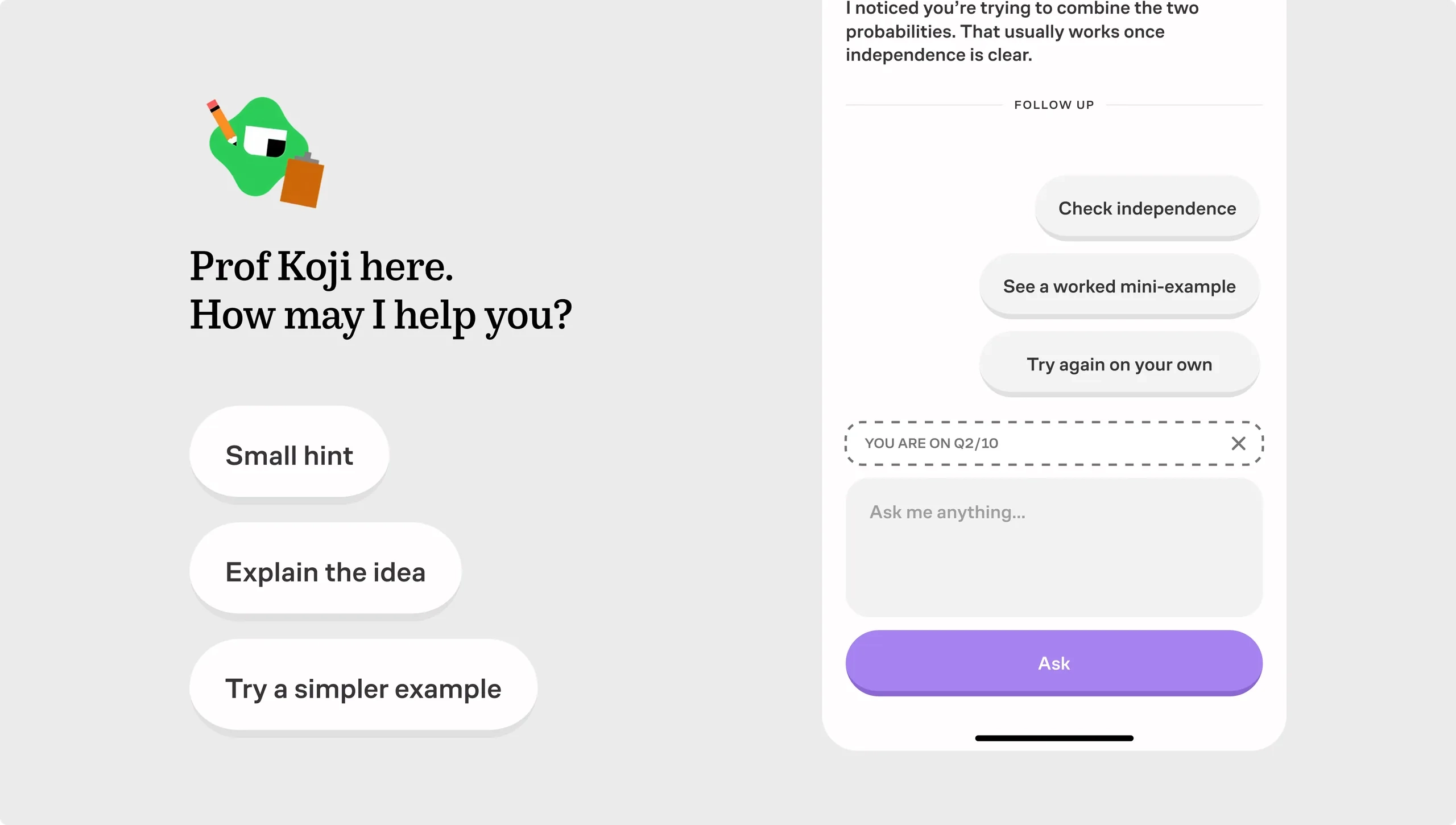
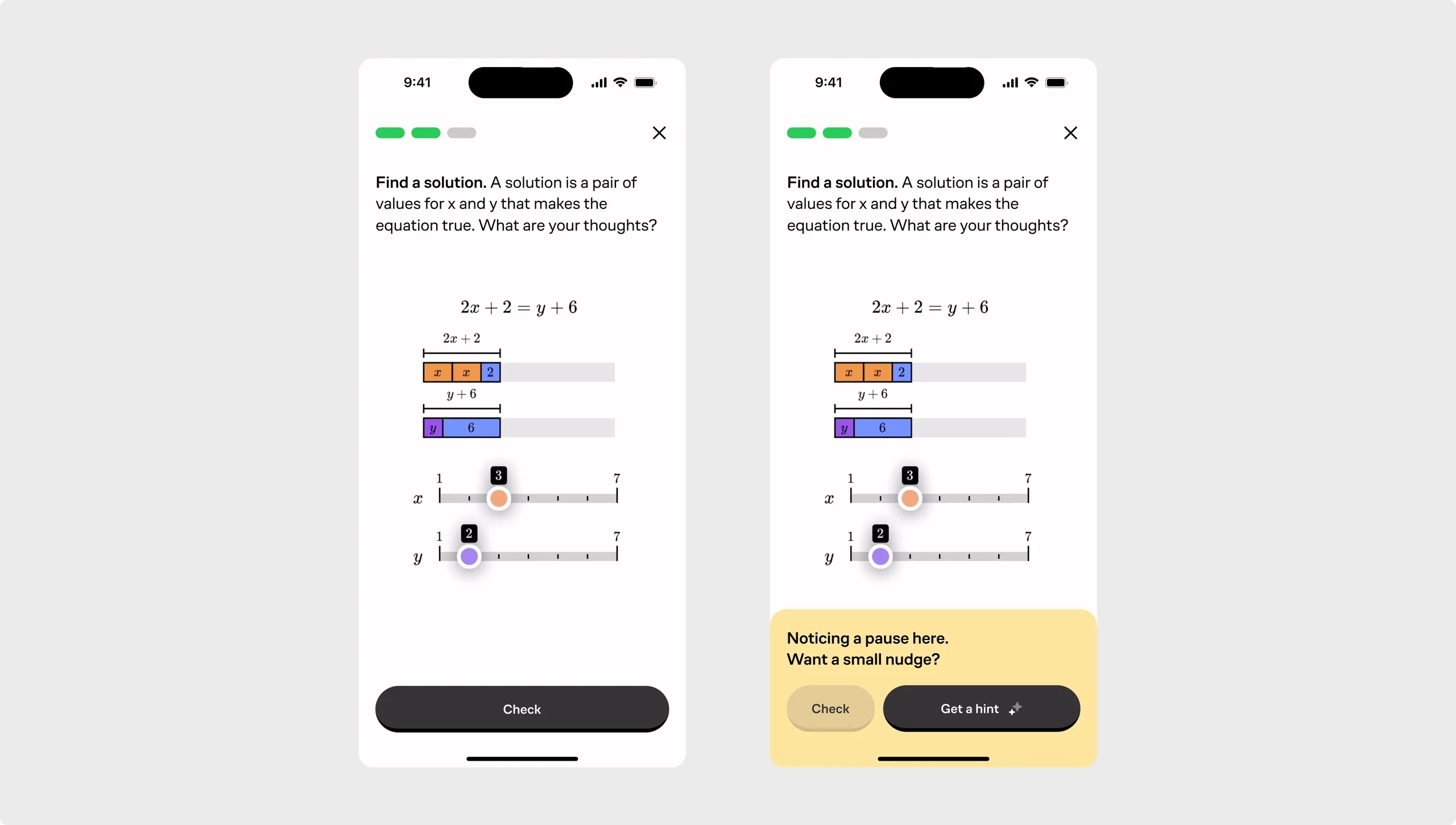
Flow 1: Getting unstuck
- Trigger: hesitation or repeated wrong attempts.
- AI behavior: Koji offers an optional nudge toward the key principle.
- Learner control: accept the nudge or keep trying alone.
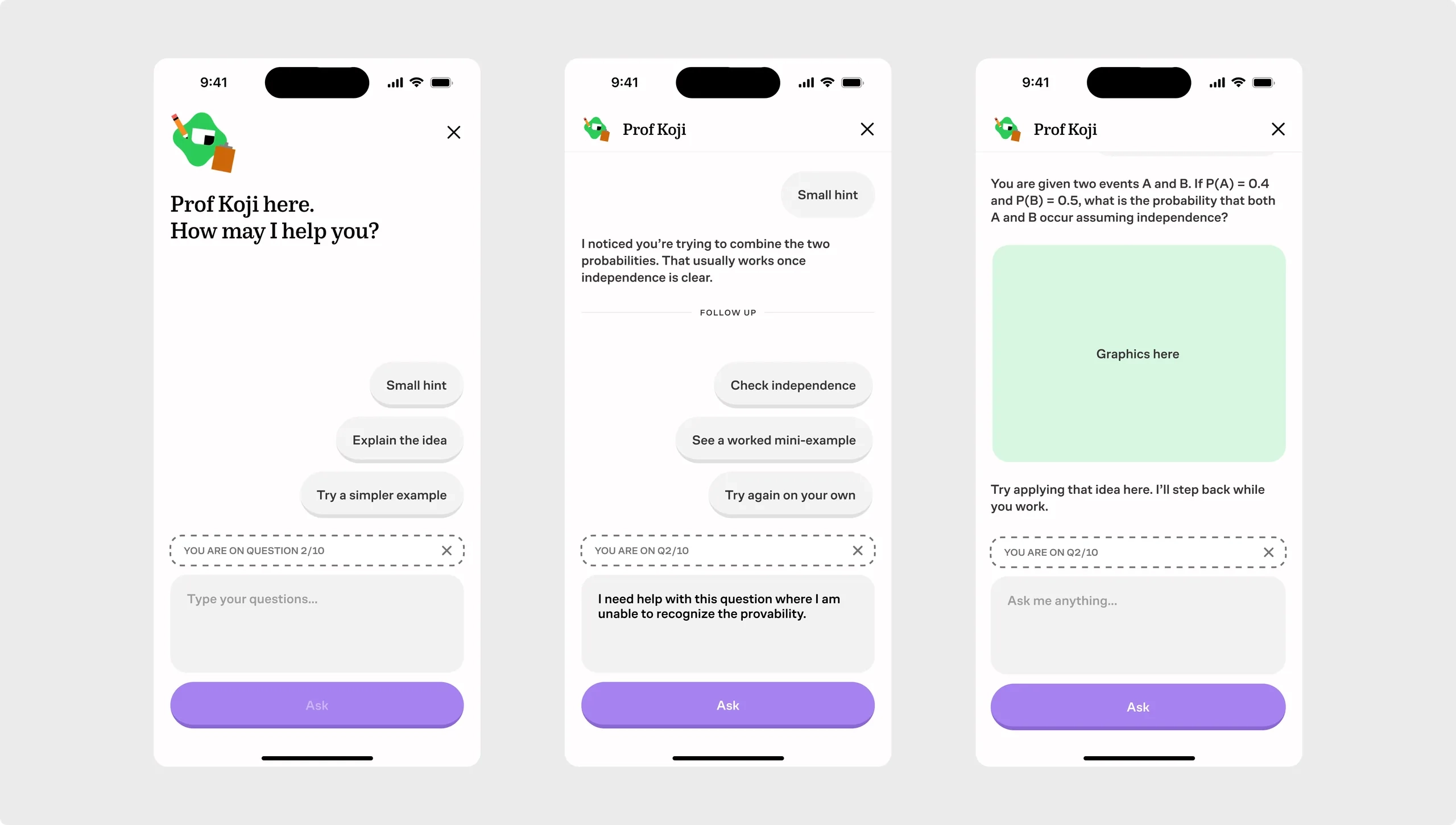
Flow 2: Chat with Koji
- Trigger: the learner asks Koji for deeper help.
- AI behavior: Socratic questions that move from concept hints to specific examples.
- Learner control: they decide how far up the help ladder to go.
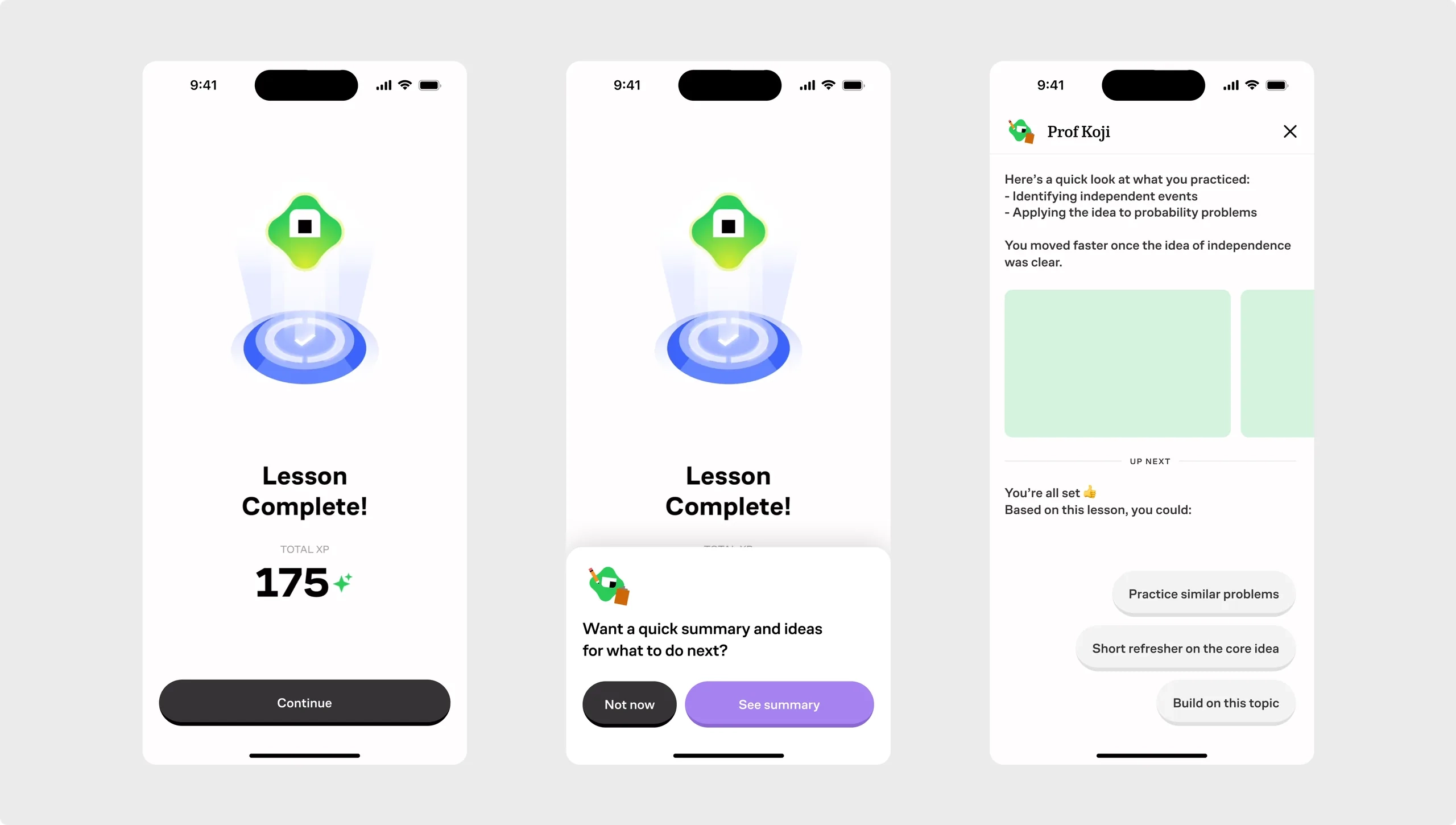
Flow 3: After the lesson
- Trigger: a lesson or module is complete.
- AI behavior: Koji summarizes progress and suggests personal next steps.
- Learner control: suggestions are options, not instructions.
Evaluation
How I would know if it works.
This is a concept, so it hasn’t been tested with learners yet. Here is how I would measure it. The North Star metric: puzzles completed after a learner gets stuck.
Is it helping learners?
- Momentum: do learners get past hard puzzles faster?
- Completion: do more learners finish the hardest levels?
- Retention: does the help lead to better scores in later lessons?
- Confidence: do learners feel more capable, not more dependent?
Is the AI behaving well?
- Timing: does help arrive at the right moment?
- Restraint: does it avoid giving away answers?
- Control: do learners feel in charge of when they get help?
Reflection
The hard part isn’t making AI smart. It’s knowing when to stay quiet.
This project showed me that good AI UX is often about restraint. The interesting design work was deciding when Koji should step in and when to let the learner think.
What I would do next:
- Test with real learners to tune the timing of each nudge.
- Make Koji explain why it offered a specific hint.
- Explore how support should change over weeks, not just one lesson.